Neil's Thoughts
Saturday, 1 August 2026
The First Ten Board Games I Would Buy for Around £350
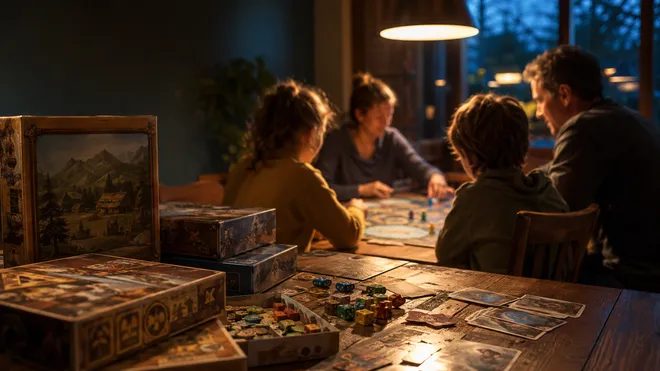
I own too many board games.
This is not an admission likely to surprise anyone who has seen the relevant shelves, although "shelves" increasingly feels like an optimistic description of several structurally significant areas of the house.
Owning a large collection does not necessarily make it easier to recommend a small one. It may do the opposite. Once you know how much variety exists, every choice brings another game to mind that does something slightly different, works better with a particular number of players or contains a mechanism you feel personally obliged to defend.
So I gave myself a more useful problem.
Imagine a couple who are relatively new to modern board games. They may have children, but they also want games they can play together after the children have gone to bed. Sometimes they will invite adult friends over. They want enough variety to discover what they enjoy without filling a room or remortgaging anything important.
They have around £350.
Which ten games would I recommend?
This is not a list of the ten greatest board games ever made. It is not even a ranking of my ten favourites. Several of my favourite games would be absurd recommendations for someone beginning a collection. A game can be excellent and still require six experienced players, an uninterrupted Sunday and the administrative discipline of a small government department.
The objective is to build a collection that will actually be played.
Each box should create a different kind of decision, interaction and evening. Some games should work with two people. Some should accommodate a larger group. There should be cooperation, direct competition, bluffing, planning and enough randomness to create surprise without making every decision irrelevant.
You are not simply buying ten games. You are choosing ten different systems in which people will spend time together.
Prices reflect typical UK pricing checked in August 2026. Shopping around should keep the collection near £330 before delivery, leaving room inside the £350 target for price variation or postage.
1. Ticket to Ride: Europe (£40)
If someone owns only one modern board game, Ticket to Ride remains one of the safest recommendations I can make. Players collect coloured train cards and use them to claim routes between cities. The European version's stations can rescue a player whose route has been blocked. It invites people through the door without making them feel that they have entered a training room.
2. Citadels (£25)
Roles, bluffing and the pleasure of correctly predicting what another person is about to do. Players build cities from district cards, but the centre of the game is the changing selection of characters chosen secretly each round. This is not a peaceful game. That is why it belongs in the collection. Sometimes you want to look another person in the eye and lie about being the Bishop.
3. Stone Age (£45)
A clean introduction to worker placement. Workers occupy shared locations to gather resources, and randomness sits inside decisions rather than replacing them. It demonstrates something important about modern games: complexity can emerge from interacting choices rather than from an enormous rulebook.
4. Marvel United (£35)
Every starter collection should include a cooperative game. This is the most immediately approachable one on the list. The theme does much of the work of attracting people to the table. The core box is enough. I say this with the authority of someone who understands the sentence intellectually.
5. Horrified (£30)
Another cooperative game, but it earns its place by creating a different experience. Classic Universal monsters, adjustable difficulty, and good cooperative conversation. Between Marvel United and Horrified, the collection gains two cooperative games with different themes, rhythms and levels of tension.
6. One Night Ultimate Werewolf (£20)
Some evenings do not need a board covered in components. They need ten minutes, several accusations and one person insisting that the app has somehow malfunctioned. Nobody is eliminated early. A complete game is short, so failure creates an immediate desire to play again. It proves that the amount of material in a box has very little relationship to the amount of noise it can generate.
7. Stonespine Architects (£35)
Design dangerous underground dungeons by drafting and arranging room cards. This gives the collection both a card-drafting game and a spatial puzzle. Even when a player is not executing a perfect strategy, they are creating something visible and distinctive.
8. Patchwork (£20)
The only game on this list designed exclusively for two players. That is deliberate. A couple starting a collection should own at least one game that is not merely acceptable with two people but built around them. There are many excellent two-player games. Patchwork is the one I would put into a first collection because it gets played.
9. Wingspan (£45)
The most substantial step up within the first ten. It is beautiful. Underneath the presentation is a proper engine-building game. Early decisions shape later possibilities. A satisfying turn can activate several abilities in sequence and make the player feel briefly as if everything in nature has arranged itself for their personal benefit.
10. Small World (£35)
The collection needs one game in which players compete directly for territory. The defining decision is when to put a civilisation into decline and select something new. Attacking another player is not a breach of etiquette in Small World. It is the game.
Why this collection works
There are games for two people and games for a roomful. Cooperation, competition, social deduction, worker placement, drafting, engine building, area control and hidden roles. More importantly, the collection allows the people playing it to discover their preferences.
A collection becomes good when it suits the people who gather around it. These ten provide enough variation to begin finding out who those people are when they play.
There is a second list for when the budget, the shelf space and the sense of proportion have all gone. That is next.
© 2026 Neil Meyer · Crawley, UK | LinkedIn | Beyond Countdown | Countdown to 2100
This page is styled as an homage to Google's Blogger platform and the Minima Ochre template. It is not affiliated with Google LLC.