The Pattern Is the Moat
Neil Meyer
AI will not give every organisation the same advantage. The difference will come from the organisational pattern the tools are asked to repeat. If that pattern is weak, AI will scale the weakness. The model is not the moat. The pattern is.

For the busy reader
AI will not give every organisation the same advantage, even when they use the same tools. The difference will come from the organisational pattern the tools are asked to repeat: the way a company thinks, decides, governs, communicates, escalates, sells, delivers, learns and corrects itself.
That pattern is partly formal architecture: values, methods, operating models, governance forums, policies, templates, standards and playbooks. It is also lived behaviour: what people actually do under pressure, when incentives bite, when customers complain, when projects drift, when boards ask difficult questions, and when nobody is watching.
Before AI, much of this codified structure was passive. It sat in folders, slide decks, onboarding material, policies, brand books, risk frameworks and delivery methods. AI changes that. Codified structure can now become active at the point of work. It can shape drafts, challenge assumptions, retrieve precedent, compare live activity against standards, and help people operate with more of the organisation's accumulated intelligence around them.
But there is a risk. If the organisation's pattern is unclear, performative or disconnected from reality, AI will not fix that. It may scale it. It may make weak thinking sound coherent, weak governance look polished, and weak delivery appear under control.
For most organisations, the model will not be the moat. Access to capable models will become normalised. The more durable advantage will come from understanding, codifying, protecting and living the pattern that makes the organisation itself.
The pattern is the moat.
---
What makes Ferrari different from Aston Martin?
Not simply the cars. Not simply the badge. Not simply the people, because people move. Designers move. Engineers move. Executives move. Agencies move. Suppliers move. Board members move. The composition of the organisation changes constantly, yet the organisation remains recognisably itself.
The same question applies elsewhere. What makes Burberry different from Dior? What makes The Guardian different from The Telegraph? What makes PRINCE2 different from Scrum? What makes one school, one board, one consultancy, one restaurant, one football club, one university or one country feel distinct from another?
The answer is not one thing. It is not the logo, although the logo may carry the memory of it. It is not the values statement, although the values may point towards it. It is not the process manual, although the process manual may preserve part of it.
The answer is the pattern.
Every enduring institution carries a pattern: a way of thinking, deciding, speaking, designing, governing, correcting, rewarding, refusing, explaining and repeating itself. Some of that pattern is formally codified. Some of it is socially inherited. Some of it sits in documents, systems, methods and controls. Some of it lives in stories, habits, taste, rituals, behaviours and judgement.
Together, those structures make the organisation recognisably itself.
This is why two organisations can sell similar products, hire from similar talent pools, use similar technology, operate in similar markets and still feel profoundly different. The difference is not only what they do. It is the structure through which they do it.
In the age of AI, this becomes far more important.
Artificial intelligence does not merely give organisations a new tool. It creates a new way of activating whatever the organisation has already codified. It can retrieve, recombine, draft, compare, summarise, challenge, accelerate and repeat the patterns it is given. Where those patterns are clear, coherent and lived, AI can turn them into organisational leverage. Where they are vague, performative, inconsistent or disconnected from reality, AI can scale the weakness.
For most organisations, the model will not be the moat. Access to capable models will become normalised, and the technical gap between one organisation's AI assistant and another's will narrow over time. The more durable question is what the model has been given to work with.
The pattern is the moat.
The infrastructure of identity
Organisations like to describe themselves through products, services, markets, values and strategy. Those descriptions are useful, but they are rarely enough.
A company is not distinctive because it has a vision statement. It becomes distinctive when the vision statement is translated into decisions, behaviours, artefacts, expectations, language, standards and trade-offs.
A luxury brand is not distinctive because it uses the word "heritage". It becomes distinctive because heritage is embedded in design choices, materials, store experience, pricing discipline, visual codes, campaign language, product restraint, leadership decisions and customer expectation.
A delivery methodology is not distinctive because it has named stages or ceremonies. It becomes distinctive because those structures create a particular relationship with uncertainty, control, accountability, evidence, authority and learning.
A board is not effective because it has a terms of reference document. It becomes effective when the structure of the board genuinely shapes the quality of oversight, challenge, decision-making and restraint.
Identity, in other words, is not merely asserted. It is operationalised.
That operationalisation requires infrastructure. Some of it is obvious: vision statements, principles, values, governance forums, decision rights, process manuals, quality standards, control frameworks, brand guidelines, tone of voice documents, design systems, operating models, risk appetite statements, escalation paths, templates, playbooks, knowledge bases, onboarding material and training.
Some of it is less obvious, but no less important: rituals, meeting rhythms, review points, product instincts, commercial judgement, inherited stories, internal phrases, examples of work people still refer to, behaviours that are quietly rewarded, behaviours that are quietly punished, and the informal understanding of what "good" looks like.
Some of this infrastructure is formal. Some is informal. Some is visible to outsiders. Some is only visible to those who have worked inside the organisation long enough to understand what the official version leaves out. All of it contributes to the pattern.
The mistake is to see this infrastructure as administrative residue. In many organisations, it is treated as the background machinery of work: necessary, perhaps dull, occasionally frustrating, often neglected. But this machinery is not separate from the organisation's value. It is part of how value is produced, repeated and recognised. If Ferrari stopped behaving like Ferrari, if Burberry stopped behaving like Burberry, if a board stopped behaving like a board, if Scrum stopped behaving like Scrum, the loss would not only be aesthetic. The pattern would have broken.
Structure operates at many levels
The pattern of an organisation is not held at one level. It is layered.
At the broadest level, there is the institutional or enterprise pattern. This is the organisation's overall identity: what it exists to do, how it describes itself, what it values, how it treats risk, how it wants to be recognised, what it will not do, and what kind of behaviour is considered legitimate.
Below that sits the functional pattern. Sales, finance, HR, legal, product, marketing, delivery, operations, customer service, risk, technology and governance all have different ways of working. Each function has its own artefacts, rhythms, controls, vocabulary, examples, tolerances and definitions of quality.
Below that sits the work-level pattern. This is the project, product, bid, client account, board paper, incident, campaign, transformation programme or operational process currently in motion. It contains local history, live constraints, people, decisions, risks, assumptions, dependencies and context.
At the top, board governance represents a fourth layer: the pattern through which oversight, challenge, decision-making and accountability are structured. This layer has its own disciplines, evidence expectations, rhythms and relationship to truth.
This layering matters because pattern is not equally transferable across levels. A company-wide value such as "customer obsession" means little until it is translated into specific behaviours inside product design, customer support, sales qualification, complaint handling, delivery governance, investment decisions and board reporting. The same phrase may require different actions in different functions. It may also create tensions between functions.
A principle such as "move fast" means one thing in a product prototype, another thing in a regulated finance process, another thing in a cyber incident, and another thing in a board decision. The phrase is not wrong, but it is incomplete until it is translated into context.
This is where organisations often mistake communication for alignment. They publish the strategy, convert it into objectives, assign workstreams, create dashboards and assume the pattern has travelled. But the real test is not whether the words travelled downward. The test is whether the pattern survived translation across contexts. The enterprise pattern must be translated into functional patterns. Functional patterns must be translated into work-level patterns. Work-level reality must be able to send evidence back upward, including evidence that the formal pattern is not working as intended. Without that loop, the organisation does not have alignment. It has broadcast.
Where the circles overlap
It is useful to think of organisations not only as hierarchies, but as overlapping systems of meaning.
A hierarchy tells us who reports to whom. A process map tells us how work is supposed to flow. A governance model tells us where decisions are meant to happen. Those views are necessary, but incomplete. The lived organisation often looks more like a series of overlapping circles: brand, operations, risk, customer promise, commercial pressure, regulatory obligation, employee behaviour, technology capability, board expectation.
The important work often happens where those circles overlap.
A product launch is not only a product event. It is a brand event, a sales event, an operational event, a support event, a legal event, a data event, a delivery event and sometimes a governance event. A customer complaint is not only a service issue. It may reveal product weakness, sales overclaim, policy ambiguity, training failure, cultural avoidance, technology debt or leadership incentives. A board paper is not only an information artefact. It is an expression of governance maturity, evidence discipline, executive honesty, risk culture, strategic clarity and decision readiness.
An AI implementation is not only a technology programme. It overlaps with knowledge management, operating model, risk, policy, workflow design, culture, cost, accountability, intellectual property, brand, customer experience and board oversight. This is where many AI initiatives are too narrow. They treat adoption as a technology circle, perhaps with a governance circle attached. But AI does not remain politely inside technology. It enters language, process, judgement, knowledge, production, communication and decision-making. It moves through the organisation's overlaps.
Effective AI integration therefore depends on understanding the overlaps, not only the org chart.
Architecture and lived behaviour
There is a second axis that matters.
Every organisation has a formal architecture: its stated purpose, strategy, governance, principles, policies, structures, standards and methods. This is what the organisation has described, codified or committed to.
Every organisation also has lived behaviour: what actually happens when people decide, prioritise, govern, sell, deliver, escalate, hire, report, challenge, reward, ignore, conceal or respond under pressure. The two are related, but not the same.
An organisation can have strong architecture and weak lived behaviour. It may have excellent policies, polished values, mature governance diagrams and impressive board papers, while the real behaviours tell a different story. In that case, architecture becomes ceremonial. It describes the organisation the institution would like to be seen as, not the organisation people actually experience.
An organisation can also have weak architecture and strong lived behaviour. This is common in founder-led businesses, high-trust teams or under-documented specialist environments. People know what good looks like. They behave well. They solve problems. They protect customers. They make decent decisions. But too much of the pattern lives in people's heads. It is effective, but fragile.
An organisation can have weak architecture and weak lived behaviour. That is drift: unclear structure, inconsistent action, local improvisation, poor memory and low accountability.
The strongest position is where architecture and lived behaviour reinforce each other. The organisation has codified what matters, and people actually behave in ways that make the codification real.
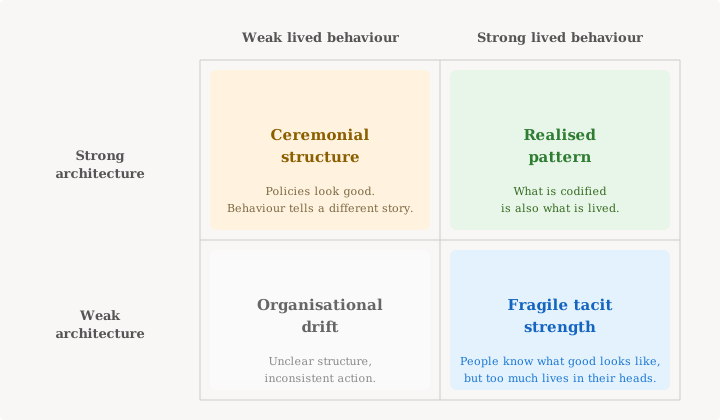
This matrix is central to the AI question.
AI can only reliably activate what has been made available to it. If the architecture is strong but disconnected from behaviour, AI may scale the official fiction. If behaviour is strong but uncodified, AI cannot easily access the wisdom. If both are weak, AI produces polished generic output over organisational confusion. Where architecture and lived behaviour are aligned, AI has something real to work with.
Codification changes when AI arrives
Before AI, codification was often passive.
A process manual sat in a folder. A brand guideline was consulted when needed. A board template shaped a monthly rhythm. A delivery method was taught during onboarding. A risk framework structured periodic review. An operating model clarified where responsibility sat. A knowledge base was searched, sometimes. These structures mattered, but they often required a human to remember, retrieve, interpret and apply them.
AI changes the economics of codification. Codified structure can become active. It can be retrieved at the point of use, applied to a draft, used to challenge an assumption, translated into a new format, compared against live evidence, embedded into workflow, surfaced during decision-making, and made available to people who would previously have needed years of organisational exposure to absorb it.
This is why AI integration is not simply automation. Automation repeats a defined task. AI-enabled codification can repeat a pattern. That is far more significant.
If an organisation has a strong proposal method, AI can help more people produce proposals that are recognisably aligned to that method. If it has a mature risk language, AI can help identify weak risk descriptions or missing evidence. If it has a distinctive editorial voice, AI can help maintain consistency across more channels. If it has clear product principles, AI can test whether roadmap ideas fit. If it has a useful board-paper discipline, AI can help improve the quality of management information before it reaches the board.
But if the pattern is weak, AI will not create coherence by magic. It will often create the appearance of coherence. This is one of the greatest risks in AI-enabled organisations: the production of fluent organisational theatre.
The same tool, different organisations
Give the same AI assistant to two delivery organisations.
The first has a clear delivery method. It knows what a good risk looks like. It distinguishes issues from risks, decisions from discussions, dependencies from excuses, and evidence from reassurance. It has consistent status reporting, known escalation routes, agreed definitions of quality, and a culture that rewards early truth rather than late optimism.
The second has templates, but no shared discipline. Risks are softened to avoid attention. Status reports are written for comfort. Dependencies are named too late. Lessons are captured and then forgotten. Escalation is treated as failure rather than governance. Different teams use the same words to mean different things.
The AI tool is the same. The outcome will not be.
In the first organisation, AI can help draft better reports, test risk quality, retrieve past decisions, compare current delivery patterns with historical failure modes, and support earlier intervention. It has a pattern to reinforce. In the second organisation, AI can make the reporting cleaner, the language smoother and the status updates faster. It may also make the underlying weakness harder to see. It has no reliable pattern to reinforce, so it learns the surface.
This is why AI maturity cannot be measured only by adoption rates, licence counts, prompt libraries or use-case inventories. Those things may matter, but they do not answer the deeper question: what organisational pattern is being activated?
Effective AI integration is translation, not installation
The language of AI "implementation" can be misleading. A tool can be installed. A licence can be assigned. A model can be integrated into a workflow. A chatbot can be deployed. A coding assistant can be rolled out. But organisational AI capability is not installed. It is translated.
The organisation must translate its existing structures into forms AI can use, while preserving the context that makes those structures meaningful. That translation work is not merely technical. It requires judgement about what the organisation is, how work actually happens, what good looks like, which structures matter, which behaviours are real, which documents are performative, which knowledge is sensitive, and which patterns are worth repeating.
At project level, translation may mean giving AI access to the specific backlog, decisions, risks, dependencies, definitions of done, stakeholder context and delivery rhythm required to assist with real work. At functional level, it may mean translating departmental ways of working into usable AI contexts: sales qualification, finance controls, HR boundaries, legal escalation, marketing voice, product principles, support scripts, delivery governance or risk language. At enterprise level, it may mean translating purpose, values, strategy, brand, policy, risk appetite, operating model and evidence standards into shared AI structures. At board level, it may mean translating governance expectations into better management information, sharper questions, clearer risk framing, decision traceability and stronger distinction between assurance and comfort.
In each case, the question is not simply: can AI make this faster? The question is: can AI make this more effective inside the right context?
Speed without context can produce organisational waste. A team may draft faster, while legal review slows down. Engineers may code faster, while product coherence weakens. Marketing may produce more content, while brand distinctiveness erodes. Delivery reporting may become easier to generate, while the underlying truth becomes harder to see. Board packs may become more polished, while challenge becomes weaker. Efficiency is not an abstract good. It is local to the system being optimised. AI enablement therefore requires efficiency that is understood in relation to the system being improved: where speed is valuable, where quality matters more, where consistency matters, where human judgement must remain primary, where automation increases risk, and where the apparent saving in one function creates cost in another.
From project to board governance
The need for context is visible at every level.
At project level, AI can support delivery planning, backlog refinement, status reporting, risk articulation, dependency mapping, decision logging, test case generation, knowledge retrieval and lessons learned. But only if it understands the actual project context. Generic project language is rarely enough. The project has history, constraints, stakeholders, decisions already made, a delivery method, a risk culture and a truthfulness problem of some kind, because almost all projects do.
At programme or portfolio level, AI can help identify patterns across work: repeated risks, dependency clusters, overloaded teams, inconsistent reporting, weak benefits logic, slow decisions, optimism bias and lessons that never become institutional memory. But again, this requires structure. The organisation must have enough consistency in its artefacts for comparison to be meaningful.
At executive level, AI can support synthesis, scenario exploration, strategic option framing, cross-functional signal detection and preparation for difficult conversations. But executive AI use without organisational grounding risks producing generic strategy language that sounds plausible and travels nowhere.
At board level, AI can support sharper governance if it improves the quality of evidence, helps expose gaps between claim and behaviour, strengthens traceability of decisions, and improves the board's ability to ask better questions. It can also weaken governance if it produces more polished packs, smoother narratives and faster reassurance without better truth. Board governance is therefore not outside the AI question. It may be one of the most important places the question lands. If AI makes organisational narrative easier to produce, boards will need to become more disciplined about the difference between narrative quality and evidence quality.
Pattern integrity
The phrase "AI alignment" is usually used in relation to the behaviour of models. That is an important field, but organisations also need a different kind of alignment conversation. They need organisational alignment.
Does the organisation's formal architecture align with its lived behaviour? Does the stated pattern show up in real decisions? Does the codified structure describe the organisation as it is, or as it wishes to be seen? Does the work-level reality support the enterprise narrative? Does the board see the pattern, or only the presentation of the pattern?
This can be thought of as pattern integrity.
Pattern integrity is not sameness. A mature organisation does not require every function, team or project to behave identically. Variation is necessary. Context matters. A legal review process should not behave like a marketing sprint. A crisis response should not behave like annual planning. A board discussion should not behave like a daily stand-up.
The question is not whether every part of the organisation looks the same. The question is whether the variation still belongs to the same underlying pattern. Burberry can produce different collections without becoming Dior. A newspaper can publish different writers without losing its editorial identity. A delivery methodology can adapt to a specific environment without ceasing to be itself. A company can allow local judgement without losing organisational coherence.
Pattern integrity is the ability to vary without dissolving.
AI makes this both easier and harder. Easier, because codified pattern can be made more available across the organisation. Harder, because generic AI output can smooth away distinctiveness, and poorly governed AI use can create many local variations that no longer belong to the same whole.
The danger of pattern theatre
There is a particular risk in organisations with sophisticated formal architecture.
The better the documentation, the easier it may be to generate outputs that look aligned. AI can produce language that references the values, uses the brand tone, follows the template, cites the strategy and appears to respect governance. That does not mean the underlying behaviour is aligned.
This is pattern theatre. It is the AI-enabled version of a familiar organisational problem: looking more coherent than the organisation actually is.
Pattern theatre is dangerous because it reduces friction at the point where friction may be useful. A clumsy report may reveal confusion. A difficult board paper may expose unresolved trade-offs. A badly written risk may show that the risk is not understood. A messy project update may signal a deeper delivery problem. AI can tidy those signals away.
This does not mean organisations should preserve bad writing, weak structure or inefficient process. It means they should be careful not to confuse improved expression with improved reality. The quality of the interface is not the quality of the organisation. The fluency of the answer is not the maturity of the thinking. The polish of the board pack is not the strength of the evidence. The speed of delivery reporting is not the same as delivery control.
As AI output becomes smoother, organisations will need to become more disciplined about asking what sits underneath it.
Protecting what makes the organisation itself
If the pattern is the moat, organisations must become more deliberate about how they codify and protect it.
The obvious AI governance question is: what data are we exposing? The deeper question is: what patterns are we exposing?
A customer list is sensitive. So is a pricing logic. So is a bid method. So is a product decision framework. So is a delivery recovery playbook. So is a risk taxonomy. So is a board reporting discipline. So is a customer success model. So is an editorial voice. So is an analytical method. So is a training pathway. So is an operating model that took years to refine.
These patterns may not always look like secrets. They may look like ordinary work documents. But ordinary work documents often contain the structure that makes the organisation effective. The AI era requires a more mature understanding of organisational IP. Not every valuable structure can or should be protected through formal intellectual property mechanisms. Some will be protected through confidentiality, access control, vendor choice, internal architecture, cultural discipline, or simply better knowledge of what is valuable.
The first step is recognition. An organisation cannot protect a pattern it has never named.
What leaders should understand before scaling AI
The least mature AI question is: which tool should we buy? A better question is: which use cases should we prioritise? A better question again is: what work changes when AI becomes available? But the deeper question is the one most organisations have not yet learned to ask: what pattern are we asking AI to repeat?
Before scaling AI, leaders need to understand which parts of the organisation's pattern are already codified, which are still tacit, which are genuinely lived, which are merely ceremonial, which create advantage, which create drag, and which should not be automated until they have been redesigned.
They need to know where consistency matters and where variation is healthy. They need to know where speed creates value and where speed increases risk. They need to know where human judgement is essential, where review is necessary, and where AI can safely support work without becoming a mechanism for laundering weak thinking.
They also need to understand which patterns are sensitive. Many organisations have spent years building methods, frameworks, customer models, delivery disciplines, knowledge bases, pricing logic, governance practices and ways of working that are commercially valuable precisely because they are not generic. Treating those patterns as ordinary content may expose more value than leaders realise.
This is not an argument for paralysis. It is an argument for sequencing. AI adoption should not wait until the organisation is perfect. It never will be. But AI adoption should be honest about what it is amplifying. If the organisation is scaling a strong pattern, AI can create real leverage. If it is scaling confusion, politics, weak evidence or ceremonial governance, AI may simply make the confusion easier to distribute.
A small implementation of the same principle
I saw this in miniature while building my own site.
The useful thing was not simply that AI could generate code, structure pages or help with content. It was that the work had nested context. The site had a purpose. Each section had a recognisable frame. Each article had a register. Each room had rules. The homepage, the professional profile, the long-form writing, the personal blog, the book page and the experimental project space were not interchangeable.
At the first level, the site had a technical and editorial boundary: its architecture, routing, deployment, design system, ownership, content rules and overall purpose. At the second level, each section had its own frame. Serious articles sat inside a controlled editorial environment. Personal writing sat inside a warmer blog environment. A book sat inside a product environment. A professional profile sat inside a career environment. Each section told the reader what kind of room they had entered, and told the writer what kind of behaviour belonged there. At the third level, each individual article had its own voice, argument, evidence, rhythm and constraint.
AI became useful in that environment because it was not being asked to create from nothing. It was operating inside nested context: site, section, artefact. It had a world to work in.
That is the principle at a small scale. The same logic applies at organisational scale: enterprise, function, work and board. The more clearly those layers are codified, and the more honestly they reflect lived behaviour, the more useful AI can become.
The future question
The future of AI in organisations will not be decided only by model capability. It will be decided by the quality of the structures into which model capability is placed.
An organisation that does not understand itself will struggle to use AI well. It may use AI frequently, impressively, visibly. But frequency, visibility and polish are not the same as advantage. To create advantage, the organisation needs to understand what makes it itself. It needs to distinguish formal architecture from lived behaviour. It needs to know which structures create value, which create drag, which are merely decorative, which are sensitive, which are transferable, and which are too dependent on tacit human memory to scale safely.
It needs to understand where efficiency is desirable, where judgement is essential, where variation is healthy, where consistency is critical, and where the intersection between functions creates more risk than any individual workflow. It needs to decide what should be codified, what should be protected, what should be exposed to AI, what should be redesigned before being automated, and what should remain human because the structure is not yet mature enough to support delegation.
These are not purely technical questions. They are questions of identity, governance, operations, culture, risk and advantage.
The pattern is the moat
AI has made intelligence more available. That does not make organisations automatically more intelligent.
For AI to create organisational advantage, intelligence has to be situated inside a recognisable, useful and well-governed pattern. That pattern must exist at multiple levels: enterprise, function, work and board. It must be codified enough to be reused, but alive enough to reflect reality. It must allow variation without losing coherence. It must support efficiency without erasing judgement. It must protect what is distinctive without starving the organisation of context.
The organisations that benefit most from AI will not simply be those with the most licences, the best prompts, the most enthusiastic engineers or the largest transformation programmes. They will be the organisations that understand themselves well enough to give AI a pattern worth repeating.
The pattern is the moat.
I work with organisations navigating this shift, fractionally, as an adviser, or as a trusted collaborator. See how I work →