What Are We Measuring When We Call Something 'AI Slop'?
Neil Meyer
AI slop is usually described as cheap, low-quality material produced in volume. But what happens when the material is accurate, useful and properly controlled? As generation becomes almost free, perhaps the better question is not who made it, but who carries the cost of deciding whether it is worth our attention.
My wife recently started buying LEGO minifigures at car-boot sales to sell on eBay.
Do you know how many LEGO-compatible, custom-printed and downright counterfeit minifigures are out there?
Lots.
Before anything reaches an auction or sales listing, we have to work out what is genuine, what is a legitimate compatible product, what has been customised, and what is simply pretending to be LEGO.
Our current sorting pile appears to be about 70% genuine and 30% everything else. Some are obvious. Others require considerably more examination than I would have expected for a very small plastic person with a yellow head.
It got me thinking about authenticity, and about how well generative AI might produce LEGO-adjacent visuals for products that do not exist.
So I tried it.
I asked GPT to produce a detailed minifigure design document for Captain Flint from Black Sails. I specified a full-colour figure in a dynamic pose, character rotation drawings, sketches on slightly creased paper, an appropriate setting and a selection of accessories.
It produced a remarkably convincing design sheet, complete with costume studies, alternative expressions, a cutlass, flintlock, spyglass, map and tricorn.
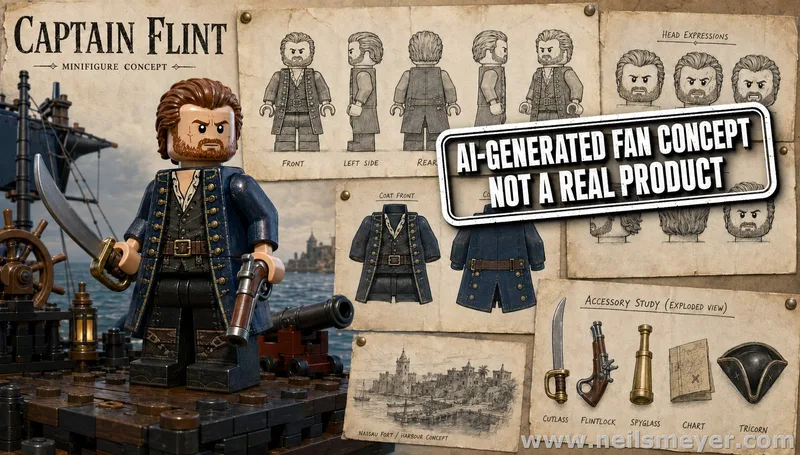
It was not a real design document.
Nobody had designed a manufacturable hairpiece, checked whether the coat decoration could be printed, or tested whether the cutlass fitted properly into a standard minifigure hand. But it looked remarkably like the artefact such a process might produce.
I tried a few more.
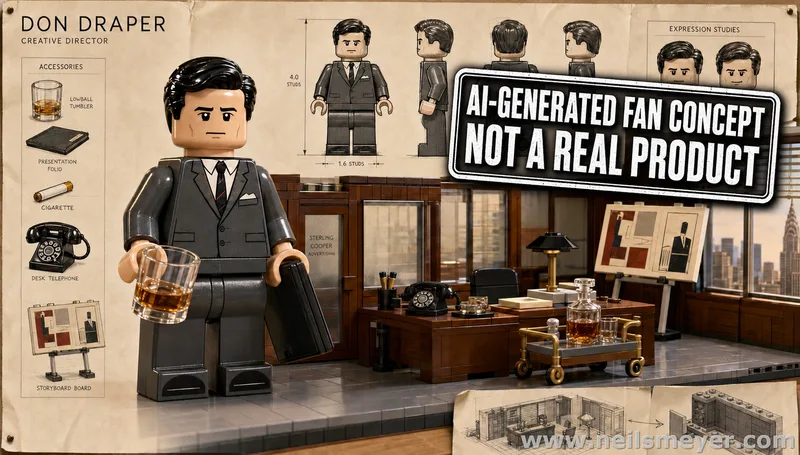
GPT gave me a Don Draper figure and office, complete with whisky, cigarette, presentation folio and desk telephone. Ted Lasso arrived with a whistle, football, tactics board, biscuits and a 'BELIEVE' sign.
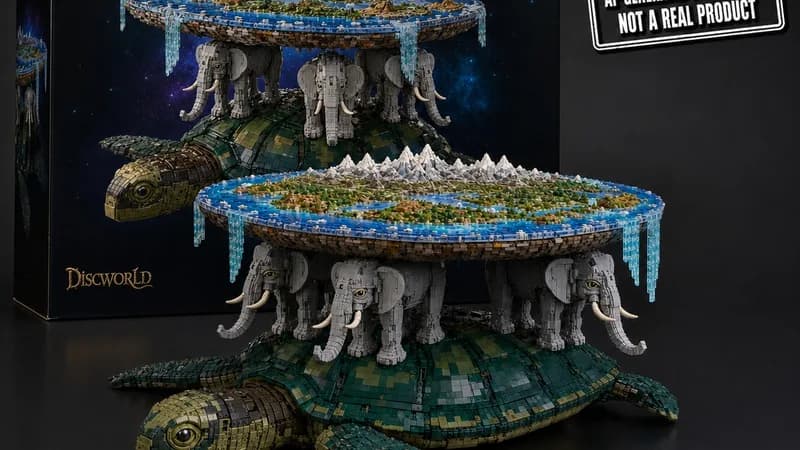
Then came complete fictional products: the Great A'Tuin carrying the Discworld, the Gem Saloon from Deadwood, the SAMCRO clubhouse from Sons of Anarchy, and an 8,742-piece collector's edition of Battlestar Galactica.
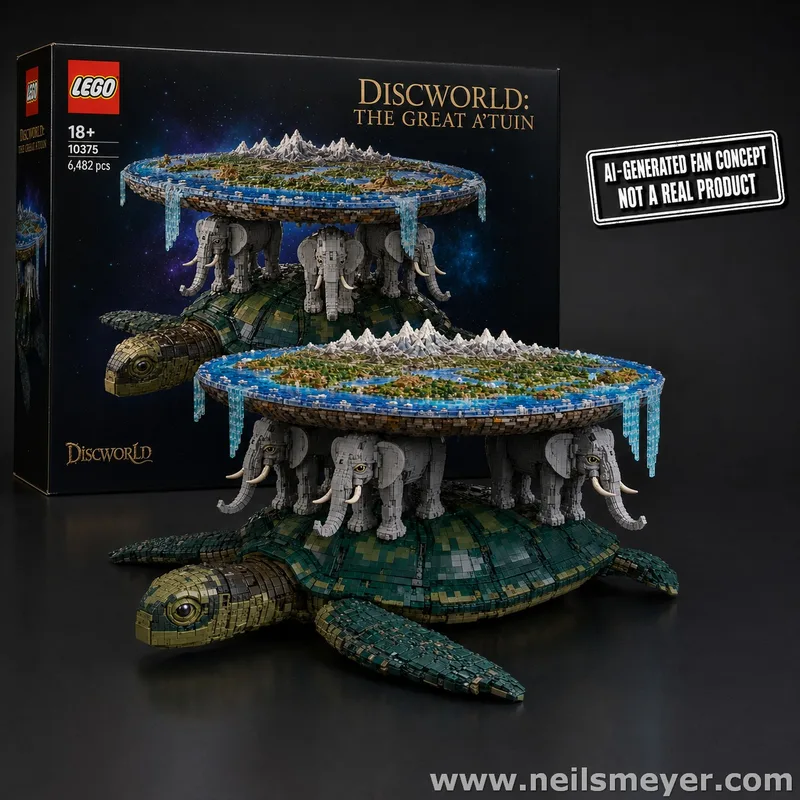

None of them exists.
None has been engineered, licensed, costed, manufactured, photographed or approved.
I still want them.
The images were created for personal enjoyment and experimentation. When I shared a selection, I marked them prominently as AI-generated. I was not trying to persuade anyone that LEGO had announced a £600 Galactica set, although I remain disappointed that it has not.
I was playing with a new tool, exploring what it could produce and enjoying the results.
Was I also producing AI slop?
A word carrying several accusations
Merriam-Webster chose 'slop' as its 2025 Word of the Year, defining it as 'digital content of low quality that is produced usually in quantity by means of artificial intelligence'.
That sounds clear enough.
The definition contains three main elements:
- digital content produced using AI;
- low quality;
- and, usually, production in quantity.
The first can be established when the production history is known.
Quantity can be counted, although the point at which several outputs become an overwhelming flood remains open to debate.
Quality is considerably more difficult.
Common use of 'AI slop' also introduces several other accusations:
- it looks bad;
- it is generic or repetitive;
- it is inaccurate;
- it required little human effort;
- it is derivative;
- it was produced using material without meaningful permission;
- it has not been adequately reviewed;
- it is pretending to be something it is not;
- it was designed to manipulate engagement;
- it displaced human creative work;
- or it has occupied attention without returning equivalent value.
These criticisms can overlap.
They are not interchangeable.
A beautiful image can still be deceptive or exploitative. An unattractive image can carry substantial personal meaning. A human-written article can be generic engagement bait. A generated image can be accurate, useful and carefully selected.
The Reuters Institute has compared AI slop with cheap SEO content, where the wider problem is not simply that an individual item is poor. Almost cost-free production can overwhelm the channels through which more valuable information has to travel.
Calling something slop provides an emotionally satisfying verdict.
It does not tell us which accusation has been proved.
A more useful definition
As I worked through the examples, I arrived at a definition that I find more useful:
**Slop is material produced and distributed at negligible marginal cost, with insufficient judgement or accountability, which transfers the burden of selection, verification or disposal to its audience.**
This does not create an objective Slop Test. Several parts still require judgement.
It does, however, explain the harm more clearly.
'Produced and distributed' separates generation from publication. An organisation can create thousands of internal possibilities without imposing them upon the public.
'Negligible marginal cost' identifies what generative AI changes. Another image, article, song or video becomes so cheap that the producer has very little financial reason to stop.
'Insufficient judgement or accountability' identifies the failure of control. Cheap production does not have to result in slop if someone remains responsible for deciding what is suitable, checking it and standing behind it.
'Transfers the burden' identifies a cost that is easily concealed. The producer saves time. Someone else has to inspect, verify, filter, correct or discard the output.
The audience may be the public. It may be a customer, a colleague, a team of designers or a potential commercial partner.
The recipient changes.
The burden does not.
Are my images slop?
Against that definition, the answer becomes more interesting than either 'yes' or 'no'.
The images were extremely cheap to produce. Each took minutes rather than the days or weeks that might be required for professional concept design, model-making and product photography.
They also depend heavily upon value created by others. The Galactica image works because the television series, production designers and performers gave the ship meaning. The Great A'Tuin works because Terry Pratchett created an idea that people already love. Every fictional LEGO package relies upon decades of product design and trust associated with the LEGO brand.
The output may be new as an arrangement.
Its value has not been independently generated.
There is also simulated craft. The design sheets imply visual development that did not occur. The packaging implies viable products. An Admiral Adama statue I generated appeared to show one coherent sculpture photographed from several angles, although no such three-dimensional object existed.
When I showed that image to Gemini and asked whether it met the definition of AI slop, Gemini confidently told me that it had been made by an experienced human sculptor and contained 'zero AI artefacts'.
It appears to have connected my generated image to an existing printable Adama bust, then converted visual resemblance into a false production history.
Once I explained that GPT had generated the image in under four minutes, Gemini retained its conclusion but changed its reasoning. It was apparently still not slop because I had supplied intention and creative direction.
This was generous.
Probably too generous.
It also showed how unstable the judgement can become. Apparent human authorship first proved that the image was not slop. When that authorship disappeared, human intention took its place.
The output had not changed.
The story around it had.
For my private use, there was no large external selection burden. I generated some images, rejected the weaker ones and kept those that pleased me. Questions about training provenance, trademarks, performer likenesses and creative labour remain, but I did not fill anyone else's feed with hundreds of unfiltered versions.
When I selected four images for a LinkedIn discussion, labelled them as AI-generated and explained what they were, I did transfer a small amount of attention cost to an audience. All publication does that. The relevant question is whether I applied enough judgement and supplied enough context to justify asking for that attention.
Some readers may decide that I did.
Others may decide that the use of AI settles the question before they consider the images.
Those are different judgements.
Looking right is not working
The Galactica image is a useful example of what current image generation does exceptionally well.
It understands the visual language of a premium collector product: dark packaging, restrained typography, a plausible set number, an implausibly large piece count, a display plaque and a line of named characters.
At a casual glance, the product feels real.
Look closely and the engineering begins to disappear. The hull contains brick-like texture rather than a consistently buildable arrangement of known parts. Elements merge. Stud patterns lose alignment. The apparent structure does not explain how the considerable weight would be carried.
It is a convincing picture of a model.
It is not a model.
I pushed the point further by asking GPT to produce a technical instruction page showing how to build a small Viper.
The result looked like an instruction page. It contained a parts inventory, step numbers, arrows, clean lighting and an exploded assembly.
The parts did not connect.
Some necessary components were missing from the inventory. Different panels showed different versions of the craft. Arrows suggested connections that could not physically work.
The image reproduced the grammar of instruction without providing reliable instructions.
This limitation will not remain fixed.
Image generation has improved dramatically over a relatively short period. It is reasonable to imagine that, over the next 12 to 18 months, a specialist system could move beyond visual resemblance and operate using legitimate product data and physical constraints.
What happens to the slop judgement then?
If LEGO could genuinely design the set
Imagine that LEGO develops a specialist model trained on assets it owns or is authorised to use.
The system understands every available element, its dimensions, connection geometry, tolerance, colour, cost and current manufacturing status. It understands LEGO's design rules, packaging constraints, safety requirements and age classifications.
It can assess structural stability, calculate a complete parts inventory, test a build sequence and produce accurate instructions.
Assume also that the relevant Battlestar Galactica rights are licensed or that the work is taking place within an appropriate rights discussion. LEGO owning LEGO assets would not give it automatic permission to use another company's intellectual property.
The system is asked to develop a Galactica collector set.
Several minutes later, it produces one.
The speed is similar to my experiment.
Almost everything else is different.
My image is a visual proposition. LEGO's output could be a manufacturable product design.
Would the short production time make it slop?
I do not think so.
The time required to generate the final design would be a poor measure of the work behind it. The organisational effort would sit partly inside:
- the authorised training assets;
- the product and engineering rules;
- the system architecture;
- the constraint models;
- the testing environment;
- the design brief;
- the selection process;
- and the final human approval.
A designer might spend ten minutes operating a system that contains decades of accumulated organisational knowledge.
Measuring only those ten minutes would misunderstand where the work occurred.
Commercial use A: asking the public
LEGO is unlikely to generate thousands of weak concepts and publish them all.
Its brand depends upon customers believing that an official LEGO product has passed through a demanding and recognisably LEGO process. Poorly controlled concepts would not merely reflect badly on individual images. They would weaken confidence in the judgement of the company behind them.
A more credible process might begin with hundreds of generated possibilities.
Those outputs would remain internal.
Systems and specialists could eliminate concepts that were structurally weak, visually repetitive, commercially unrealistic or insufficiently aligned with the brand. Designers might review the strongest twenty, develop five and physically test two or three.
LEGO could then show the public three controlled options and invite a vote.
The public would not be required to sort through the hundreds of rejected ideas.
LEGO would have retained the cost of:
- technical validation;
- product judgement;
- intellectual-property control;
- selection;
- and accountability.
The three public concepts may have been generated much faster than conventionally produced alternatives. They would not meet the stronger definition of slop simply because AI participated.
The company has not transferred its filtering problem to the public.
It has offered the public a controlled choice.
Commercial use B: pursuing the licence
Now consider a use that never reaches the general public.
LEGO believes there may be a market for Battlestar Galactica, but it has not yet secured the licence. Within an appropriate legal and commercial process, it uses its system to develop several internal concepts before, or as part of, approaching the rights holder.
Those concepts might help the parties assess:
- whether the property translates convincingly into LEGO;
- which ship, location or character group offers the strongest opportunity;
- likely product size and price;
- the difference between a play set and a display model;
- and the quality of execution the rights holder could expect.
Only a small number of people may ever see the work.
It still has genuine commercial value.
Its purpose is not to entertain the public. It is to reduce uncertainty and support a decision.
This is important because unpublished material is not automatically waste. Organisations routinely create concepts, scenarios, prototypes, draft proposals and financial models that are ultimately rejected. Their value may lie partly in allowing rejection to take place before the organisation makes a larger commitment.
Generative AI could make that exploratory stage much faster and broader without producing any additional public material.
Slop can remain inside the organisation
Keeping material private does not automatically make the process responsible.
Imagine that one LEGO employee generates 10,000 concepts and sends all of them to a design team with a short message:
Please find the good ones.
The selection burden has still been transferred.
It has simply moved to colleagues.
The person generating the material has saved time by creating a much larger filtering cost elsewhere in the organisation. Ownership is clear. The material may never become public. It can still become organisational slop.
A mature system therefore needs more than generation. It needs constraint, evaluation, ranking and decision gates.
The technology should reduce the search space presented to specialists, not expand it until human attention becomes the bottleneck.
The same principle applies well beyond product design.
An employee can produce 200 pages of AI-generated analysis and ask a manager to find the useful conclusions. A supplier can respond to a tender with a vast document that transfers verification to the buyer. A team can generate dozens of proposals without taking responsibility for recommending one.
The apparent productivity belongs to the producer.
The cost appears somewhere else.
Value depends upon the recipient
The same image can carry different value in different settings.
For me, the Great A'Tuin image has personal and imaginative value.
For a LinkedIn audience, it may have conversational value.
For LEGO, it could have research value.
For an intellectual-property holder, it could have decision value.
For someone deceived into believing it is an announced product, it has negative informational value.
For a design team given 500 versions to inspect, it may represent an unwanted workload.
The pixels might be identical.
The purpose, accountability and burden are not.
This makes quality partly a question of fitness for purpose. A licensing concept does not need to be a finished manufacturing specification, but it must be sufficiently accurate for the decision it is intended to support. A public product image carries a different evidential burden. A private piece of fan art has another standard again.
The audience does not merely receive content.
It receives a claim, an expectation and some portion of the work required to assess both.
Does ownership change the answer?
Ownership changes several important parts of the judgement.
If LEGO uses authorised LEGO assets, it addresses questions about its right to reproduce the brand's design language. If the relevant entertainment property is also licensed, the position becomes stronger again. The organisation can establish provenance, impose controls and remain accountable for the result.
Ownership does not directly create quality.
LEGO can own a bad image. An enthusiast can produce a good one.
Nor does corporate ownership provide automatic ethical immunity. A company can use material it owns to produce repetitive, manipulative or unwanted output. It can automate creative work in ways that affect employment. It can use the efficiency of AI to lower costs without sharing any of the benefit with workers or customers.
Ownership tells us something about:
- authority;
- permission;
- provenance;
- and accountability.
It does not tell us whether the result is useful, attractive or worthy of attention.
There is also an uncomfortable status question.
If I create an imaginary Galactica set using GPT, it can be dismissed as AI slop.
If LEGO produces a similar image using an internal model, it may be described as a concept, prototype or AI-assisted product innovation.
Some of that difference is legitimate. LEGO would possess authority, engineering knowledge, controls and accountability that I do not.
Some of it is institutional status.
The technology can appear more respectable when a trusted corporation places it inside an approved workflow. 'Slop' may therefore become partly a judgement about who is authorised to generate, rather than only about what was generated.
Quality production and public acceptance
Even a properly licensed, structurally valid and carefully reviewed AI-assisted set could face another problem.
Some people would still call it AI slop.
They would not necessarily be judging the quality of the design.
'AI slop' is sometimes used descriptively. It identifies cheap material released with inadequate selection, verification or accountability.
It is also used as an emotional and cultural sanction. Here the use of generative AI is itself considered illegitimate, regardless of the observable quality of the result.
The underlying objection may be that:
- the training process was exploitative;
- creative labour has been devalued;
- a machine has entered a role that should belong to a person;
- the producer is claiming creative standing they have not earned;
- the work participates in a harmful economic transition;
- or synthetic production is incompatible with authentic artistic expression.
Those concerns should not be dismissed merely because the resulting set is excellent.
A product can be technically impressive while the labour model behind it remains objectionable.
A product can also be ethically produced and still be poor.
The difficulty is that 'slop' sounds like a judgement about the artefact while sometimes functioning as a judgement about the producer's behaviour or values.
Someone may say:
The output is accurate, useful and carefully reviewed.
And receive the answer:
It is still AI slop.
At that point, quality was never the real charge.
The term has moved from evaluation to enforcement.
The public boundary may differ from the real one
This creates a difficult decision for companies considering how to use generative AI.
A company might say:
Our products are designed by talented human creators. AI does not replace human creativity.
That sounds clear until we look inside the process.
Perhaps AI:
- identified which licensed properties had unmet demand;
- generated early visual propositions;
- compared hundreds of possible structures;
- recommended part substitutions;
- tested build sequences;
- modelled costs;
- identified likely customer groups;
- or ranked concepts for human review.
The final design may have been selected, modified, built and approved by people.
It would still be difficult to claim that AI made no creative contribution if it materially shaped the options from which those people selected.
The public statement may be:
Humans designed and approved the product.
The operational reality may be:
Humans directed, constrained, selected, tested and accepted a product whose option space was partly generated by AI.
Neither statement is necessarily false.
The second tells us considerably more.
'Human-made' and 'AI-made' will become increasingly poor descriptions of mixed production processes. The useful questions will be:
- Where did AI contribute?
- What was it allowed to influence?
- Which assets was it authorised to use?
- What was independently checked?
- Where did human judgement enter?
- Who remained accountable?
- What was communicated to customers and partners?
LEGO's public material already suggests governed adoption rather than a simple rejection of AI. Its 2024 Data Ethics Policy says that it has developed internal artificial-intelligence principles and that its data ethicist works with an AI Centre of Excellence on the ethical concerns of predictive and generative AI.
A LEGO Education leadership role advertised in 2026 included responsibility for the responsible integration of emerging AI into products and workflows.
I have not found a public statement confirming that generative AI is used in the creative design of conventional LEGO sets. Nor have I found a public policy categorically excluding it from that work.
It is entirely possible that LEGO will place a particularly strong boundary around final creative design, whether because of technical risk, concern for designers or the importance of human imagination to its brand.
Such a decision might tell us as much about culture and corporate positioning as it does about the capability of the tools.
Two risks, not one
Companies will increasingly have to manage two separate risks.
The first is the risk of producing slop in the operational sense: poor or excessive material released without adequate judgement, control or accountability.
That risk can be reduced through:
- authorised data;
- specialist models;
- technical constraints;
- human review;
- clear decision rights;
- controlled publication;
- and named accountability.
The second is legitimacy risk: well-produced material may still be rejected because an audience objects to the use of generative AI.
That cannot be solved simply by improving the output.
An organisation can avoid the use, limit it, explain it, defend it or wait for attitudes to change. It can also use AI quietly, although that creates a future transparency problem if public assumptions about human authorship are allowed to persist.
This is not a theoretical communications issue.
For many organisations, the publicised boundary between human and AI contribution may become a brand decision before it becomes a capability decision.
The company will need to ask:
Can this technology produce a good result?
It will also need to ask:
Will our customers continue to regard the result, and us, as authentic if we use it?
What should we measure?
I do not think we need a numerical Slop Score.
Giving subjective judgements decimal places would create precision without certainty.
We can still ask better questions:
Is the output fit for its purpose?
Is it coherent, accurate, specific and useful for the audience receiving it?
My Galactica image works well as an imaginative visual proposition. It fails as a product design or building instruction.
Who applied judgement?
Was there meaningful selection, editing, testing and verification, or was the output passed directly from model to audience?
Human involvement does not automatically produce quality. Its absence increases the chance that errors and empty pattern reproduction reach publication unchecked.
Who remains accountable?
Is there a person or organisation willing to stand behind the result, correct it and absorb the consequences when it fails?
Who carries the selection and verification burden?
Did the producer narrow the possibilities and check the claims, or has that work been transferred to the recipient?
Is the provenance sufficiently clear?
Can the audience understand what it is seeing and how it was produced?
An AI label helps. It does not answer every question about training material, source influence, intellectual property, performer likenesses or employment.
How is it distributed?
Was the material invited, selected and contextualised, or generated at a volume designed to occupy every available surface?
What value does the recipient receive?
Information, entertainment, beauty, practical utility, emotional connection and better decisions are all forms of value.
This is subjective.
Removing it from the assessment would be absurd.
Is the objection actually to AI participation?
If the material remains unacceptable even when it is accurate, authorised, controlled and useful, the disagreement is about the legitimacy of the production method.
That is a valid subject for debate.
It should be stated as such.
Generation is cheap. Judgement is not.
My fictional LEGO images were made quickly.
They contain design and engineering work that never happened.
They depend upon creative and commercial value produced by other people.
They also gave me pleasure, prompted discussion and made ideas visible that would otherwise have remained in my head.
Labelling them as AI-generated does not settle every ethical question.
Nor does the fact that AI was involved prove that they are worthless.
As the tools improve, visible defects will become a progressively weaker way of identifying slop. We will encounter synthetic outputs that are coherent, accurate, licensed, structurally valid and professionally reviewed.
The more useful question will be whether someone cared enough to decide what should be made, what should be checked, what should be shown and what they were willing to stand behind.
Generative AI makes production extraordinarily cheap.
It does not make judgement free.
If a producer retains the work of selection, verification and accountability, the output may provide genuine value, even when much of it was generated by a machine.
If the producer passes that work to everyone else, we have a better reason to call it slop.
And if the output remains unacceptable because AI participated at all, we are having a different argument.
That argument is not really about quality.
It is about what we are prepared to recognise as legitimate creation.
I work with organisations navigating this shift, fractionally, as an adviser, or as a trusted collaborator. See how I work →