Still Waiting for the Plateau
Neil Meyer
AI may plateau technically before its consequences do. Four years after DALL·E 2, the more important question is what reorganises around it.

In September 2022, I waited three months for access to DALL·E 2 and was astonished that a computer could make an image I described.
The prompt was deliberately awkward: a blacksmith forging a steampunk computer. I then asked the system to interpret the scene as paintings by Titian and Edward Hopper.
Looking at the results now, neither image is extraordinary by 2026 standards.
That is rather the point.
Four years later, AI can see, hear and speak. It can make images, music and video, write and test software, use tools, operate computers and remain with increasingly complicated sequences of work.
The distance between those two moments is shorter than some technology programmes I have worked on.
I am beginning to think the most important part of that story is how little time four years actually is.
Peter's plateau
Peter and I catch up about once a quarter for lunch.
The format is fairly consistent. About 50% is 'what have you been up to?', 30% is 'remember when?', and the remaining 20% tends to become 'you know what I found really interesting...'.
The percentages are ballpark.
At our latest lunch, artificial intelligence occupied a fair amount of that final 20%.
Peter said that when the current generative-AI wave began, he expected something familiar. There would be a large initial spike of novelty, plenty of early adopters, interesting trials, questionable business cases and a great deal of money spent on things that would never make it into normal use.
Then the excitement would fall away.
A smaller collection of genuinely useful applications would survive, and AI would settle into its place as a meaningful addition to software and technology delivery.
I thought that was a perfectly reasonable expectation.
Anyone who has spent long enough around technology has watched versions of that cycle play out before. Something new arrives. Vendors discover that whatever they were selling last week is suddenly an ideal platform for it. Executives ask for a strategy. Pilots multiply.
Eventually, the less glamorous questions arrive.
Does it work? Can we integrate it? Who owns it? What does it cost at scale? Is anybody still using it once the novelty wears off?
Weak products disappear. Useful capabilities become ordinary. The market moves on.
Peter has changed his view.
'I now think it will be much more than that.'
So have I.
Not because I think every forecast of artificial general intelligence is correct, or because progress must continue at its recent pace indefinitely. I do not know where the technical ceiling is, and neither does anybody else.
The change in my view comes from a different question.
What if we are waiting for one plateau when several different things are moving on different curves?
Model capability may slow while reliability continues improving. Costs may fall while benchmark scores flatten. Product novelty may fade while integration accelerates. Adoption may remain shallow in one industry and become structural in another.
Most importantly, the technology could plateau before its consequences do.
I was impressed by two pictures
By the time I received access, DALL·E 2, Midjourney and Stable Diffusion had begun turning natural-language image generation into a recognisable category.
I was not mapping that larger trajectory. I was simply astonished by what the system had made.
I ended my LinkedIn post with:
'Remember... these images did not exist until Dalle created them based on my text input! This really does feel like we're living in a time of wonders!'
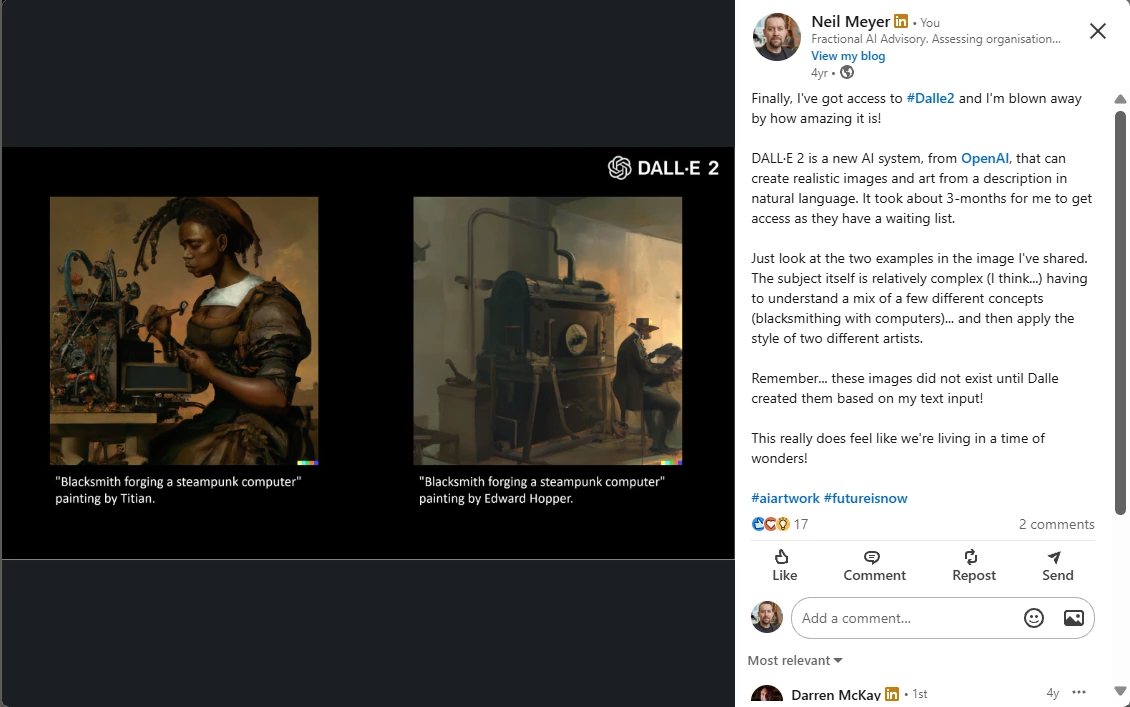
I am glad I wrote that down at the time.
It is easy to look backwards and quietly upgrade our former expectations so that we appear to have understood the future rather better than we did.
My reaction was not, 'This will restructure knowledge work and become a geopolitical competition involving hundreds of billions of dollars of infrastructure.'
It was, roughly, 'Bloody hell, look what it made.'
Then ChatGPT arrived on 30 November 2022.
Language models already existed. GPT-3 had been available through an API since 2020, and the research history stretches much further back. What changed for the public was the interface.
Ask something. Receive an answer. Ask a follow-up.
It required almost no explanation.
Within months, generative AI had moved from something many people had seen demonstrated to something they could sit down and use themselves.
That was the first boundary to disappear.
From making things to doing things
The years since ChatGPT can be described as a long list of models and release dates.
GPT. Claude. Gemini. Llama. DeepSeek. Qwen.
DALL·E. Midjourney. Stable Diffusion. Sora. Veo.
That timeline is impressive, but it is also a distraction. Individual products will change, merge, lose their lead or disappear. A paragraph declaring which model is best would have an unusually short life.
The more durable story is the sequence of boundaries being crossed.
The first systems made things. A sentence became an image. A description became a voice, a piece of music or a short video.
Then the categories began to converge. Models could work across text and images, listen and respond through speech, and combine generated video with dialogue, sound and effects.
Reasoning changed as well. Systems such as OpenAI's o1 and DeepSeek's R1 demonstrated that giving a model more computational effort to work through a difficult problem could materially improve the result. The interaction was no longer always prompt in, immediate answer out.
Then advice began turning into action.
In October 2024, Anthropic put 'computer use' into public beta. Claude could inspect a screen, move a cursor, click and type. Coding systems were also changing character. The early promise had been autocomplete on steroids; increasingly, coding agents could inspect repositories, modify several files, run tests, investigate failures and continue through a task.
That seems like a small change in description.
It is an important change in kind.
A system that tells a person what to do still depends on that person carrying every step into another environment. A system that can use the environment begins to participate in the work itself.
Stanford's 2026 AI Index gives one indication of the movement. Performance on SWE-bench Verified, built around real software-engineering issues, moved from around 60% to close to the reported human baseline in a year. On OSWorld, which measures agents performing computer tasks across operating systems, accuracy rose from roughly 12% to 66.3%.
Benchmarks require caution. Stanford itself discusses contamination, gaming and poor-quality questions. Passing a test does not mean an AI can safely replace an experienced software engineer or operate unsupervised through a company.
The speed of movement is still difficult to ignore.
By September 2026, model providers were releasing new systems weeks apart. Google described Gemini 3.8 Flash as its third Flash release in six weeks. DeepSeek followed with V4.1-Flash, adding visual understanding to another new architecture. OpenAI's safety assessment for GPT-6 Astra described it as the first broadly deployed OpenAI model to reach the company's 'Critical' threshold for cybersecurity capability.
The claim is not that each release changes the world.
It is that the frontier has moved from generating a strange picture to systems working across information, media, software and action in less than six years.
The current generative-AI wave has crossed more functional territory than the label 'chatbot' can sensibly contain.
The categories are disappearing
When image generation becomes a normal feature inside ChatGPT or Gemini, image generation has not become less important. It has stopped requiring a separate destination.
The same process is moving through ordinary commercial software.
AI is appearing in office suites, development environments, search, design tools, customer-service platforms, healthcare applications, legal systems, financial services and enterprise software.
That makes 'AI adoption' a progressively awkward thing to measure.
If I deliberately open ChatGPT, I have obviously used AI.
If my meeting software transcribes an hour of conversation, identifies actions and drafts a summary, have I?
If a bank uses machine reasoning somewhere inside a fraud decision, did I use AI?
If a developer works in an environment where some code was suggested, generated, reviewed or tested by a model, where exactly does ordinary software development finish and AI-assisted development begin?
Stanford reports that 88% of surveyed organisations were using AI in 2025, up from 78% the year before.
That number should not be confused with transformation. Buying licences is easy. Changing an organisation is not.
OpenAI says ChatGPT has more than one billion weekly active users. Again, reach does not tell us depth. A billion people asking occasional questions is different from a billion people reorganising their work around AI.
The significant movement is happening underneath those headline numbers.
The enterprise market is increasingly concerned with connecting models to organisational information, permissions, workflows and decisions. The model becomes one component inside a larger operating environment.
Palantir, for all the other arguments it invites, provides a useful example. Its AIP proposition is not simply access to a clever model. It connects AI to the data, rules, systems and processes through which an organisation operates.
That is considerably more consequential than asking a chatbot to rewrite an email.
It also explains why the smartphone comparison keeps returning to me.
Five years into the smartphone
The first iPhone appeared in 2007.
It was not the first smartphone. BlackBerry, Nokia, Palm and others deserve rather more historical credit than they sometimes receive when the story begins with Steve Jobs walking onto a stage.
What followed is more useful to this argument.
Apple opened the App Store in July 2008 with more than 800 applications. Ten million apps were downloaded in the first weekend.
The phone became a platform on which other people could build things its manufacturer had not originally imagined. Within a few years it was absorbing cameras, maps, music players, navigation and the web. Applications added banking, shopping, transport, payments, work, games, dating and social media.
By March 2012, roughly five years after the first iPhone, Pew found that 46% of American adults owned a smartphone.
That was already a major technology shift.
It was nowhere near the end of the story.
Look at the device now. Banking authentication assumes it exists. Airlines put tickets on it. Maps assume live location. Parking, messaging, restaurant bookings, delivery services and large parts of family and professional life are organised around it.
You can choose not to own a smartphone.
The rest of society has made that choice progressively more inconvenient.
The deep change was not that everybody bought a better telephone. Other systems adapted around the expectation that the device would be there.
Some consequences were useful. Others took longer to understand and were considerably less benign. Recommendation systems changed what people encountered. Advertising models rewarded attention. Misinformation acquired new routes through society. Political actors learned to use the same infrastructure that carried holiday photographs and football arguments.
Very few of those consequences could have been understood by reading the original feature list.
The comparison with AI is not a forecast of an identical adoption curve. Smartphones required new physical devices and offered immediate consumer benefits that many AI systems still struggle to match. AI faces real constraints around reliability, energy, data, cost, regulation and trust.
The comparison is useful for a narrower reason.
A technology can reach technical maturity long before institutions finish reorganising around it.
Smartphones did not need to become twice as capable every year for banking, transport, authentication and social life to continue adapting to their presence.
AI could stop making spectacular benchmark gains tomorrow and still spend the next decade spreading through systems that already exist.
The plateau in capability and the plateau in consequence may be separated by years.
What moves after the novelty fades
This is why I am wary of assessing AI primarily by asking whether today's chatbots are overhyped.
Some undoubtedly are.
Some products will fail. Some companies attracting enormous valuations will disappear. Features described as revolutionary today will become an unremarkable button in somebody else's software.
None of that answers the more important question: what else changes because the capability becomes widely available?
A meeting summary sounds small until organisations stop keeping minutes any other way.
Code generation sounds like a productivity feature until teams change shape, entry routes narrow and the assumptions behind delivery planning move with them.
Automated research sounds convenient until people stop visiting the sources from which the answer was assembled.
A generated voice sounds entertaining until identity checks, fraud controls and the evidential value of a recording all have to adapt around it.
Each individual use can look incremental. The surrounding system carries the larger change.
I wrote an entire book, *Countdown to 2100*, which spends rather more time than is comfortable looking at AI, automation, labour, governance and concentrations of economic and political power.
The scenarios are deliberately speculative. They are not claims that one particular future is inevitable.
The underlying concern is less speculative.
If productive capability, information and increasingly decisions move into systems controlled by a relatively small number of companies or governments, access to AI stops being only a technology issue. It begins affecting power and agency.
What has surprised me since writing the book is the pace at which some of the enabling conditions have continued to develop.
The race does not look like a normal software market
There is plenty of ridiculous commentary around AI.
Some forecasts extrapolate a short period of rapid progress indefinitely. Every few weeks another profession apparently has eighteen months left to live. Valuations sometimes appear to assume several mutually incompatible futures all happen at once.
I am not convinced by all of it.
We do not need to accept the most extreme claims to notice how seriously governments and capital markets are behaving.
Stanford estimates that private AI investment in the United States reached $285.9 billion in 2025. US generative-AI investment alone was estimated at $163.6 billion.
OpenAI, SoftBank and Oracle announced the Stargate project in January 2025 with an intention to invest $500 billion in US AI infrastructure over four years. By September, the partners said announced sites represented more than $400 billion of planned investment.
Those are not normal numbers for adding a useful feature to office software.
Governments are framing the issue just as aggressively. The United States called its July 2025 strategy Winning the Race: America's AI Action Plan.
It is worth noticing the wording before arguing about the policy.
The US government is explicitly treating AI leadership as an economic, technological and national-security competition.
China's approach differs in language and political structure, but not in ambition. Chinese models have closed much of the performance gap, with systems from DeepSeek, Alibaba, ByteDance, Tencent and others competing at significant scale.
The UK is much smaller in this race, but the logic is visible here as well. The government's AI Opportunities Action Plan committed to expanding sovereign AI compute capacity twentyfold by 2030, followed by billions of pounds in public commitments to compute infrastructure and AI-enabled public services.
A recurring incentive sits underneath these decisions.
If we slow down and somebody else does not, they get there first.
For a company, 'there' may mean a valuable market, a cost advantage or control of an important platform.
For a government, it is increasingly framed as competitiveness, sovereign capability or military advantage.
Each actor can therefore have a rational reason to accelerate while agreeing that some of what is being built deserves caution.
That should worry us.
Not because I know which particular AI risk becomes decisive. I do not.
The problem is the incentive structure. The presence of hype does not make the investment, competition or pressure to continue imaginary.
Waiting is also a decision
The expectation of a plateau can become comforting.
It suggests that organisations, governments and individuals can wait for the noise to clear. The weak products will disappear, a stable set of capabilities will emerge, and sensible decisions can begin once the technology has found its proper place.
That is often good advice when buying software.
It is less useful when the surrounding environment is changing before the product category settles.
Waiting does not preserve the starting position. During the wait, suppliers become embedded, data and workflows move, skills atrophy or develop, teams change shape and dependencies accumulate.
The choice is not between adopting everything now and calmly deciding later.
It is between making deliberate decisions under uncertainty and allowing a sequence of local purchasing, productivity and convenience decisions to establish the future by default.
That does not require every organisation to build its own model or rush into every available tool.
It requires more ordinary disciplines:
- knowing where AI is already entering through existing suppliers;
- separating experimentation from operational dependence;
- deciding which information and decisions should remain under direct control;
- measuring outcomes rather than counting licences;
- and making somebody accountable for the consequences, not merely the deployment.
None of those decisions depends on knowing whether the next benchmark rises by five points.
They depend on recognising that technical uncertainty does not prevent institutional change.
Still waiting
Peter's original expectation was not that AI would disappear.
He thought the excitement would fade, the weak experiments would die, and a useful technology would find its proper place inside software delivery.
Four or five years ago, that would have sounded like a reasonably bullish view.
Now I think it may be the conservative one.
My old LinkedIn post helps remind me why.
In September 2022, I waited three months for access to a system that could make a painting of a blacksmith forging a steampunk computer.
I thought it was wonderful.
It was.
But look at what we considered remarkable then, and compare it with what has become relatively ordinary only four years later.
Then go back to smartphones at the same age.
Five years after the first iPhone, smartphones were clearly important. Almost half of American adults owned one. App stores, maps, social media and mobile internet were already changing behaviour.
We still had not seen the full effect of building banking, authentication, transport, photography, retail, entertainment, work and large parts of our social lives around the assumption that everybody carried one.
AI has one significant advantage over the smartphone as a mechanism for spreading.
It does not have to wait for us to buy another physical device.
It can simply appear inside the things already around us.
I do not know where the technical plateau is. It may be closer than the most enthusiastic forecasts suggest. Progress will not continue at the same rate forever, and adoption will remain uneven between industries, countries and people.
That is different from assuming we can wait for the excitement to pass before taking the wider implications seriously.
Peter changed his view because the evidence changed.
So have I.
The plateau in model capability may arrive next year, or it may remain out of sight for much longer.
The reorganisation around it has already begun.
And I find the speed at which everyone seems determined to discover the rest considerably less comforting than those two DALL·E pictures were four years ago.
I work with organisations navigating this shift, fractionally, as an adviser, or as a trusted collaborator. See how I work →