The Games That Taught Me to See Systems
Neil Meyer
I collect board games because I enjoy them. Looking back, I suspect they have also shaped how I think about AI, governance and the systems we build around intelligent tools.
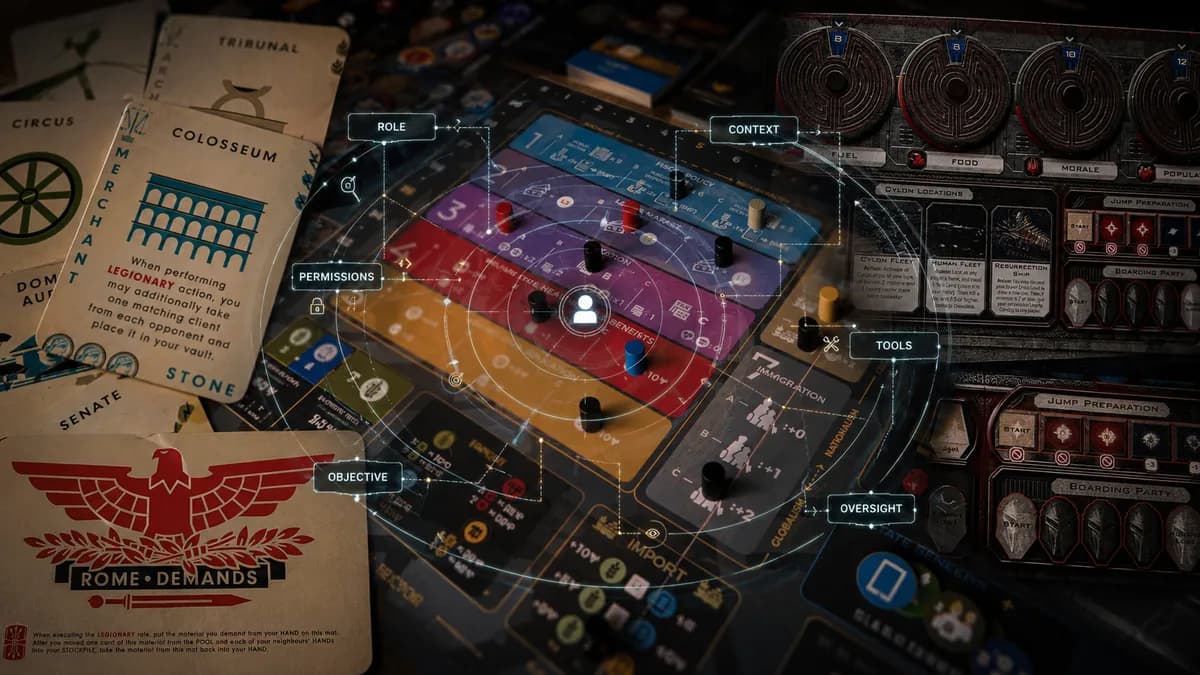
I collect board games because I enjoy them. Looking back, I suspect they have also shaped how I think about AI, governance and the systems we build around intelligent tools.
I collect and play board games because I enjoy them.
I do not believe every leisure activity has to justify itself by becoming professional development. Actually, I believe the opposite. The tactile, physical nature of offline activities such as board games is more important than ever, as is the separation of work and play.
There is quite enough optimisation in the world without calculating the governance value of an evening spent fighting over cardboard sheep.
Looking back, however, I suspect that board games have influenced how I think. They have made me interested in the relationship between written rules and actual behaviour, between what participants are told to achieve and what the system rewards, and between the apparent simplicity of individual mechanisms and the complexity that emerges when they interact.
Regardless of how carefully we create boundaries between work and play, the subconscious mind runs according to its own rules and logic.
And it is very good at recognising patterns.
I thought I was choosing games
In my previous article, I tried to choose the first ten board games I would recommend to a couple, perhaps with children, who wanted to start a collection for around £350.
The list had to cover family time, evenings as a couple and gatherings with adult friends. It needed games that people could learn without first completing an apprenticeship in cardboard administration. It also needed enough variation that buying ten boxes did not result in owning ten slightly different ways of collecting coloured cubes.
I ended up with games including Ticket to Ride: Europe, Stone Age, Patchwork, Horrified, Wingspan and Small World. I then added a second list for the point at which money, available time and concern for one’s dining table had been thrown out of the window. That list included Glory to Rome, Battlestar Galactica, Hegemony and Twilight Imperium.
At the time, I thought I was choosing games.
In practice, I was choosing systems.
Each game creates a different relationship between rules, information, authority, cooperation, competition and consequence. Some give every player the same capabilities. Others assign radically different roles. Some make information public. Others depend upon secrecy, uncertainty or deception. Some reward the individual who extracts the greatest value from a shared environment. Others require people to cooperate, although not necessarily in equal measure.
The pieces, cards and artwork give those systems personality. The mechanisms make them work.
This may be one reason board-game enthusiasts can spend an unreasonable amount of time discussing whether a game is elegant, balanced, broken, too random, insufficiently interactive or vulnerable to a dominant strategy. We are not only talking about whether the game was enjoyable. We are examining the relationship between its design and the behaviour that appeared around the table.
That is also a substantial part of what I do when considering organisations and AI.
Have games trained my attention?
I am not a machine-learning engineer. Owning Twilight Imperium has not qualified me to build a large language model. It has not even reliably enabled me to find six people willing to surrender an entire day to playing it.
Board games may, however, have trained my attention.
They encourage you to ask what each participant knows, what they are permitted to do, which resources they control and how their objectives differ. They make you watch for feedback loops, compounding advantages, unintended combinations and strategies that comply with the rules while undermining the apparent spirit of the game.
It would not surprise me if many of the engineers building AI systems also had shelves full of board games.
I can only speculate about their hobbies. I have not conducted a survey of AI laboratories or inspected the private collections of data scientists. The overlap would nevertheless make intuitive sense. Board games reward curiosity about what happens when relatively simple rules interact, when participants pursue different objectives, and when a carefully designed environment produces behaviour that nobody explicitly wrote into it.
I can provide at least some evidence from my own experience of software engineering teams.
For a period, I hosted weekly gaming evenings attended by members of the teams with whom I worked. They were not disguised retrospectives, team-building exercises or attempts to smuggle capability development into people’s personal time. We played games because playing games together was enjoyable.
Even so, the attraction was not entirely accidental.
Software engineers spend much of their working lives inside systems of rules, dependencies, permissions and exceptions. They anticipate what will happen when one component changes, look for edge cases and discover routes through a system that its designers may not have expected. A board game offers many of the same intellectual pleasures, except that the system is contained in a box and failure rarely results in an urgent production call.
Around the table, I also saw people interact with systems differently. Some wanted to understand the full rule set before making their first move. Some learned by doing. Some optimised immediately. Some experimented to see what the game would permit. Some pursued the stated objective. Others became fascinated by a mechanism and followed it even when it was not the most efficient route to victory.
None of this turned the evening into an assessment centre. It did remind me that the same system does not produce the same behaviour from every participant.
The rules are not the game
A rulebook describes a game, but the rulebook is not the game.
The game emerges when people begin making decisions inside the structure the rules create.
A designer may intend several strategies to be equally viable. Players may discover that one is considerably stronger. A rule intended to create occasional tension may become the focus of every turn. A small early advantage may compound until the remaining hour feels like a ceremonial confirmation of something everyone already knows.
Players also bring behaviour that is not written on any card. They negotiate, threaten, cooperate, remember previous betrayals and decide whether attacking the person who taught them the game would be strategically unwise or emotionally satisfying.
The formal system and the social system operate together.
Anyone who has played a cooperative game with a determined and experienced player will recognise this. The rules may allocate equal agency to everyone around the table. The social reality can still become one person directing four pairs of hands.
Nothing in the rulebook says that one player is now the executive decision-making function. The structure has nevertheless permitted it to happen.
Organisations make a similar mistake when they assume that publishing a policy means they have designed a functioning system. The documented rule is only one influence upon behaviour. Incentives, access, convenience, habit, status and local workarounds will also determine what people actually do.
AI systems make this particularly visible.
An organisation may have an acceptable-use policy, an approved model, a system prompt, an access-control process and a named owner. Each element can appear reasonable when examined separately. Their interaction may still produce excessive reliance, hidden workarounds, transferred accountability or uses that comply with the wording while frustrating the purpose.
The useful question is not only whether the rules are present.
It is what kind of game those rules produce once people and AI systems begin operating inside them.
The model is not the whole system
Public discussion about AI often concentrates upon the model. We compare benchmark scores, context windows, reasoning performance, speed and price. These things are relevant, just as the intelligence and experience of a player can affect the outcome of a board game.
But the player is not the game.
A capable player placed inside Patchwork can choose between available pieces, manage buttons and arrange a quilt. The same person placed inside Hegemony encounters classes, taxation, public services, wages, trade and political influence. Their general capacity to reason has not disappeared, but the environment gives that capacity a different purpose, different information and a different set of possible actions.
Something similar happens when a general-purpose language model is turned into an agent.
The model provides part of the underlying capability. The system around it supplies a role, instructions, context, memory, tools, permissions and an objective. It may also determine which actions require approval, which records are retained, how performance is evaluated and when a person must intervene.
This surrounding structure is sometimes described as a harness. The word is useful because it directs attention away from what the model might theoretically be capable of doing and towards what it can and should do in a particular setting.
A board-game designer makes comparable decisions.
The designer determines:
- what role each participant occupies;
- what information they can see;
- which actions are available;
- which resources they control;
- when they are allowed to act;
- what success looks like;
- how the rules are enforced;
- and what happens when the game reaches its end.
These are not incidental details added after the interesting design work has been completed. They are the design.
The same should be true when organisations introduce AI agents. Choosing a powerful model and then adding a paragraph telling it to be careful is not the equivalent of designing a controlled operating environment.
*Glory to Rome*: purpose, role and permission
Glory to Rome is one of my favourite games and one of the more difficult games to explain to somebody seeing it for the first time.
Much of its brilliance comes from the fact that cards do not have one fixed identity. Depending upon where and how a card is used, it can become a building, a material, a client or part of the value stored in a player’s vault. The card remains physically unchanged. Its function is created by its position within the system.
Players also lead and follow roles such as Architect, Craftsman, Labourer, Merchant, Patron and Legionary. Choosing a role is not cosmetic. It determines what can happen next and how other players may respond.
This is a useful way to think about AI personas.
The same underlying model can be instructed to operate as a researcher, a communications assistant, a procurement adviser or a policy reviewer. The persona gives the model a purpose and influences how it interprets a request. A legal-review agent should approach a contract differently from a marketing agent asked to develop campaign ideas.
But a persona is not a permission system.
Telling an AI agent that it is a cautious procurement adviser does not technically prevent it from accessing confidential employee records, sending an external email or approving a payment. It may be instructed not to do those things. If the tools and permissions remain available, however, the instruction is carrying more risk than it should.
A role tells an agent what it is there to do.
A permission determines what it is capable of doing.
In a board game, the permitted action space is normally enforced by the design. I cannot announce that my role in Glory to Rome is now Chief Financial Officer and move somebody else’s cards into my vault because this better reflects my personal interpretation of Roman commerce. The rules and the other players will object.
AI implementations need equivalent boundaries. Some controls can be expressed through instructions. Others must exist in access rights, tool design, approval gates, transaction limits and technical separation.
A persona can shape behaviour. It should not be expected to carry the full weight of control.
*Battlestar Galactica*: trust without complete visibility
The Battlestar Galactica board game creates tension through incomplete information.
Players are trying to help the human fleet survive a series of crises and reach safety. Some may secretly be Cylons. Loyalty can change or be revealed. Contributions to important tests are partly hidden. A harmful outcome may be the result of sabotage, limited resources, poor judgement or simple bad luck.
You rarely know everything another player knows.
This does not make rational assessment impossible. It changes the kind of evidence available. You observe decisions, compare explanations, remember patterns and consider whether someone’s behaviour remains plausible across several rounds.
One questionable action is not proof. Several questionable actions accompanied by an implausibly enthusiastic defence of airlock safety may deserve closer attention.
The lesson for AI is not that language models are secretly Cylons.
They do not need concealed loyalty, consciousness or Machiavellian intent to create a problem. The relevant similarity is that we make judgements about their reliability without possessing complete visibility into every influence that produced a response.
We can inspect the instructions given to an agent, the context supplied, the tools it called, the output it produced and some of the consequences. We cannot take a single confident answer and reconstruct from it a complete, human-readable account of why the model arrived there.
The model is also interpreting each request through patterns shaped by its training and subsequent configuration. It may give an answer that appears sensible while relying upon associations, assumptions or omissions that are not immediately visible to the person receiving it.
This means trust cannot rest upon tone.
A fluent answer is not necessarily a correct one. A cautious answer is not necessarily well-founded. An agent describing itself as safe, unbiased or compliant tells us very little about whether the surrounding system makes those qualities likely.
Trust must be supported by evidence: repeated evaluation, constrained action, appropriate monitoring, records of material activity and the ability to intervene.
In Battlestar Galactica, uncertainty is part of the entertainment. In an AI system handling customer decisions, financial transactions or employee information, uncertainty requires a different response.
We may not be able to know everything the system is drawing upon. We can still decide how much authority it receives while we are finding out.
*Hegemony*: the system has a point of view
Hegemony is a game about classes, economic interests and political power.
The Working Class, Middle Class, Capitalist Class and State do not simply begin with different coloured pieces. They occupy different structural positions, control different resources and pursue different routes to success.
A policy that is attractive to one class can impose costs upon another. Higher wages, taxation, public services, privatisation, education and trade are not abstract questions floating above the game. Their effects depend upon where a player sits within its economy.
The game does not require everyone to agree about what a good society looks like. It gives participants incentives that make disagreement understandable.
This is useful when considering claims that an AI system is neutral.
Models do not arrive from nowhere. Their behaviour can be influenced by the material used during training, decisions about filtering and exclusion, the people asked to evaluate responses, the objectives of post-training, the system specification, the information retrieved at the point of use and the commercial environment in which the product is deployed.
Ownership can influence many of those choices, consciously or unconsciously. It would be too simple to say that a model merely adopts the ideology of the company that owns it. Large training sets contain contradictory material, organisations contain competing interests and model behaviour is not the expression of one coherent corporate mind.
It would be equally naive to conclude that ownership, incentives and institutional context are irrelevant.
Consider an AI system asked to discuss economic policy. The available evidence, the prominence of particular sources and the assumptions embedded in evaluation can affect whether capitalism is treated as the neutral starting point and other systems as deviations requiring explanation.
Or consider an image generator asked to show a successful executive. If its outputs repeatedly favour white men in expensive offices, the system may be reproducing patterns that were common in the material from which it learned. It is not necessary for an engineer to have written a rule saying that success should look male and white. Historical representation can become statistical expectation.
This is not only a hypothetical concern. The researchers behind *Stable Bias* examined three widely used text-to-image systems and found that their depictions of professions both correlated with US labour demographics and consistently under-represented marginalised identities.
This is one of the more uncomfortable characteristics of complex systems. Bias does not require a visibly biased instruction. It can emerge from accumulated choices, uneven evidence, inherited classifications and an objective that fails to account for who carries its costs.
NIST’s work on AI bias makes a similar point. It identifies systemic, computational and statistical, and human forms of bias. These can interact across datasets, organisational practices, testing and human decision-making. Bias is not simply a contaminated ingredient that can be removed from the training data while everything else remains neutral.
Hegemony encourages the player to ask who benefits, who pays, who has influence and who gets to define a successful outcome.
Those are also useful questions to ask of AI.
Games make optimisation visible
Board games are unusually honest about objectives.
They usually tell us how to win.
Players then adjust their behaviour accordingly. If victory points come from building cities, people build cities. If points come from collecting birds, laying eggs or completing tickets, those actions acquire value because the system has declared them valuable.
Sometimes a game’s theme suggests one objective while its scoring system rewards another. A player supposedly building a flourishing civilisation may discover that the most efficient strategy involves repeating one narrow action or accumulating something with little thematic justification.
The player has not necessarily misunderstood the game. They may have understood its incentives better than its story.
AI systems also respond to what we reward and measure. If a customer-service agent is evaluated primarily on speed, it may resolve cases quickly by transferring work elsewhere. If a recruitment tool is rewarded for reproducing historical indicators of successful appointments, it may preserve the patterns already present in the organisation. If a content system is rewarded for engagement, it may learn that accuracy, proportion and social value are optional complications.
We often describe these as technology failures. Sometimes they are failures to define what winning should mean.
A capable system will find routes through the environment we give it. The more capable it becomes, the less sensible it is to rely upon the hope that it will pursue the spirit of an objective rather than its measurable form.
AI researchers describe one version of this as specification gaming: behaviour that satisfies the literal specification of an objective without achieving the outcome its designer intended.
Board-game players know this instinctively. If a legal strategy is sufficiently effective, somebody will try it. If it spoils the game, the designer may need to change the rules rather than complain that the player lacked the intended attitude.
Where the analogy stops
Board games are useful for thinking about systems partly because they are bounded.
The board has an edge. The components are known. The rules are intended to remain stable for the duration of play. Participants have agreed, at least in principle, to take part. A victory condition normally exists and the game eventually ends.
Organisations and societies possess none of this tidiness.
Their rules can be ambiguous, contradictory or selectively enforced. Objectives change. Participants enter and leave. Informal power can outweigh formal authority. People affected by a system may never have consented to join it. Consequences cannot always be reversed by putting the pieces back into the box.
AI operates in that messier world.
This is why a board game should not be treated as a complete model of AI governance or social behaviour. A game designer can deliberately exclude most of reality in order to make a particular experience possible. An organisation cannot remove every inconvenient complexity from customers, employees, laws, markets and public expectations.
Nor should we confuse balance with fairness or entertainment with safety. A mechanism can be enjoyable precisely because it creates tension, betrayal or dramatic inequality. Those qualities require much more care when the resources are jobs, money, medical treatment or legal rights rather than wooden cubes.
The limitations do not make games useless as analogies. They help define what games can show us.
They make designed choices visible.
Roles, permissions, information, objectives and enforcement are usually exposed on the table. In operational technology, the same choices can disappear beneath technical language or be treated as inevitable properties of the tool.
They are not inevitable.
Someone designed the game the system is being allowed to play.
Play for pleasure, but notice what happens
I do not want this argument to end with a recommendation that every leadership team schedule a compulsory board-game evening and appoint someone to capture the learning outcomes.
That would be a particularly efficient way to remove the pleasure from it.
Board games deserve to be played because they are enjoyable. They bring people into the same physical space. They give our hands something to do and our attention somewhere to settle. They allow us to negotiate, compete, cooperate, tease, complain and recover without every interaction being mediated by a feed, notification or algorithmic recommendation.
The tactile nature of play has its own value. Moving a piece across a board, shuffling cards, looking somebody in the eye while they make an obviously questionable promise and sharing the consequences of a decision are experiences that a screen does not reproduce completely.
As more work becomes digital and more of our interaction is processed through systems designed to capture attention, physical and bounded play may become more valuable rather than less.
The patterns remain available if we want to notice them.
After a game, we might find ourselves wondering:
- What behaviour did the game actually reward?
- Did its practical incentives support its stated objective?
- What could each participant see, and what remained hidden?
- Which actions were impossible, and which were merely discouraged?
- Did an early advantage become self-reinforcing?
- Did anyone discover an exploit or unintended combination?
- Did the culture around the table change the formal game?
- Was a poor outcome caused by a player, or by the system surrounding them?
There is no need to ask these questions aloud after every session. Nobody wants a post-implementation review after Citadels.
But some part of the mind notices.
The game around the intelligence
Board games did not teach me how to train a model, design a neural network or build the infrastructure behind an AI service.
I suspect they taught me to look beyond the apparent intelligence of the player and examine the game around it.
What role has been assigned? What information is available? Which actions are permitted? What behaviour is rewarded? What assumptions have been built into the environment? Who can observe what happens? Who can change the rules or remove a participant from the table?
These questions sit at the centre of AI governance, but they are not exclusively technology questions. They are questions of systems design.
The attraction of powerful AI can make the model appear to be the whole story. It is the most visible participant and often the most impressive component. Yet capability does not determine purpose, permission or accountability. Those come from the system people construct around it.
Perhaps years of board games made that easier for me to see.
Perhaps they simply gave an existing interest in systems somewhere colourful to play.
Either way, I will continue collecting and playing them for the reason I started: because I enjoy them.
If they also help me notice how rules become behaviour, how incentives become strategies and how simple mechanisms become complex systems, that is a welcome consequence.
It is not the price of admission.
Play the game because it is worth playing.
Notice the system because, whether you intend to or not, part of you probably will.
I work with organisations navigating this shift, fractionally, as an adviser, or as a trusted collaborator. See how I work →